WOMEN IN SCIENCE WITHOUT BORDERS (WISWB)
Advancing Inclusive Science Diplomacy from Africa to the World
Women in Science Without Borders (WISWB) is a global initiative founded in Egypt by Professor Amal Amin, a distinguished polymer technology and chemistry expert at the National Research Centre. Established with a vision to harness science for societal development, WISWB promotes inclusive, multi-and-transdisciplinary collaboration and equitable global partnerships as the foundation of effective science diplomacy. As a co-founder of the Global Young Academy and a Fellow of the International Science Council, Professor Amin connects grassroots initiatives with global platforms, ensuring that the voices and contributions of African women scientists are represented in international science diplomacy discussions.
Active in 92 countries and recognized by UNESCO, WISWB directly contributes to the Sustainable Development Goals, particularly SDG 5 (Gender Equality) and SDG 17 (Partnerships for the Goals). Its origins in Egypt challenge traditional North-driven models of science diplomacy, demonstrating that transformative leadership can emerge from the Global South and expand globally.
At its core, WISWB provides a free networking platform connecting scientists with stakeholders across policy, industry, the private sector, NGOs, media, and the public. Through its flagship World Forum for Women in Science – hosted in several countries including Egypt, South Africa, Brazil, and Iraq, the initiative builds science-based communities, fosters international research partnerships, and delivers leadership and science diplomacy training.
WISWB is particularly impactful in crisis and conflict settings, where it supports and amplifies the voices of at-risk and displaced scientists. By advocating for policies that enable refugee researchers to continue their work, the initiative demonstrates how science can serve as a neutral platform for dialogue, cooperation, and peacebuilding in contexts where political solutions may be limited.
Through dedicated training in science communication, leadership, entrepreneurship, and science diplomacy, WISWB equips scientists with the skills needed to bridge research and policy. It encourages scientists to embrace a dual identity: not only as specialists in their disciplines, but also as peaceful change makers committed to addressing societal challenges.
WISWB therefore stands as a powerful example of how inclusive and equitable science diplomacy can advance sustainable development, strengthen global partnerships, and amplify women’s leadership in science. By placing collaboration, visibility, and capacity building at its core, the initiative continues to demonstrate the transformative role science can play in promoting peace and shared progress.
From the President
As we begin the year, it gives me great pleasure to introduce the first edition of the NASAC E-Bulletin for 2026.
The Science Networker reflects the vibrancy and diversity of scientific activity across our network. It reaffirms the central role of academies in addressing Africa’s development priorities.
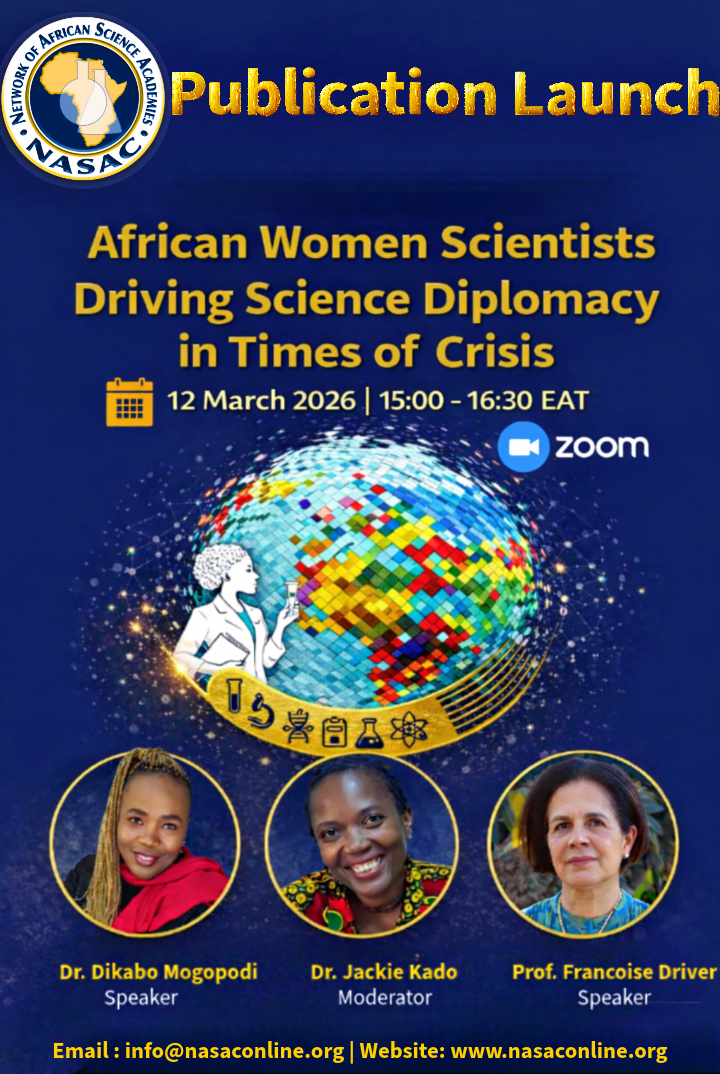
In this issue, we feature the inspiring work of Women in Science Without Borders, founded by Prof. Amal Amin. This initiative highlights the importance of cross-border collaboration and the empowerment of women in science. We also note the soft launch of NASAC’s publication, African Women Scientists Driving Science Diplomacy in Times of Crisis, held on 12 March 2026. The publication underscores the vital role of African women scientists in shaping science diplomacy during times of crisis.
We are pleased to highlight several important developments across our network. The Nigerian Academy of Science made a number of distinguished appointments of eminent professors to key roles. Among them, I am personally honoured to have been conferred the title of Emerita Professor by the University of Calabar. We also congratulate our colleagues in Cameroon and Uganda on the election of new Council members. These milestones reflect continued renewal and strong leadership within our academies. Our member academies remain active and engaged. Highlights from the Benin Academy showcase impactful events and initiatives that contribute to national and regional development.
We are deeply saddened by the passing of Prof. Roseanne Diab, Vice President of the Academy of Science of South Africa (ASSAf). We extend our heartfelt condolences to her family, colleagues, and the wider scientific community. Her life and work stand as a lasting tribute to her dedication to science and service.
Over the past months, our academies have continued to demonstrate resilience and commitment. They are advancing research, strengthening institutions, mentoring the next generation, and engaging governments with evidence-based advice.
As NASAC, we remain committed to fostering collaboration among African academies. We will continue to amplify African scientific voices and promote science that responds to societal needs. I encourage you to engage with the stories in this bulletin. Let us continue working together to advance science for sustainable development across the continent.
We look forward to a productive and impactful year ahead.
Prof. Ekanem Ikpi Braide, FAS
President, NASAC
NASAC PUBLICATION
African Women Scientists at the Frontlines of Science Diplomacy
At a time when the world is grappling with intersecting crises from climate change and pandemics to conflict and socio-economic instability, African women scientists are emerging as influential actors in science diplomacy. A newly released NASAC publication, African Women Scientists Driving Science Diplomacy in Times of Crisis, shines a spotlight on these trailblazers whose scientific expertise and leadership are shaping policy, fostering international cooperation, and advancing inclusive solutions across the continent.
The publication documents compelling case studies of women scientists who operate at the intersection of science, policy, and diplomacy, demonstrating how scientific evidence can inform decision-making even in the most challenging contexts. Their work spans critical areas such as public health, climate resilience, food security, and emerging technologies, fields where timely, credible scientific input is essential.
Beyond individual achievements, the report underscores a broader message: empowering women in science is not only a matter of equity, but a strategic imperative for Africa’s development and global engagement. By amplifying African voices in international scientific and diplomatic spaces, these women are helping to reposition the continent as a knowledge producer and solution provider.
This publication reaffirms NASAC’s commitment to gender-responsive science systems and to strengthening Africa’s role in global science diplomacy through inclusive leadership.
Several virtual meetings are planned for March and April 2026:
WfS Publication Soft Launch – 12 March 2026
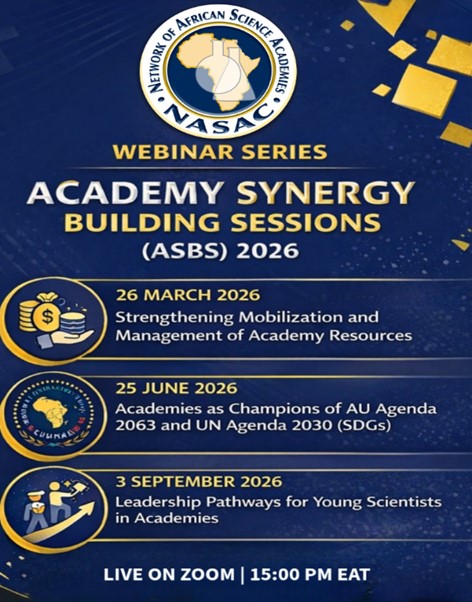
ASBS I: Strengthening Resource Mobilization and Management for Academy Projects – 26 March
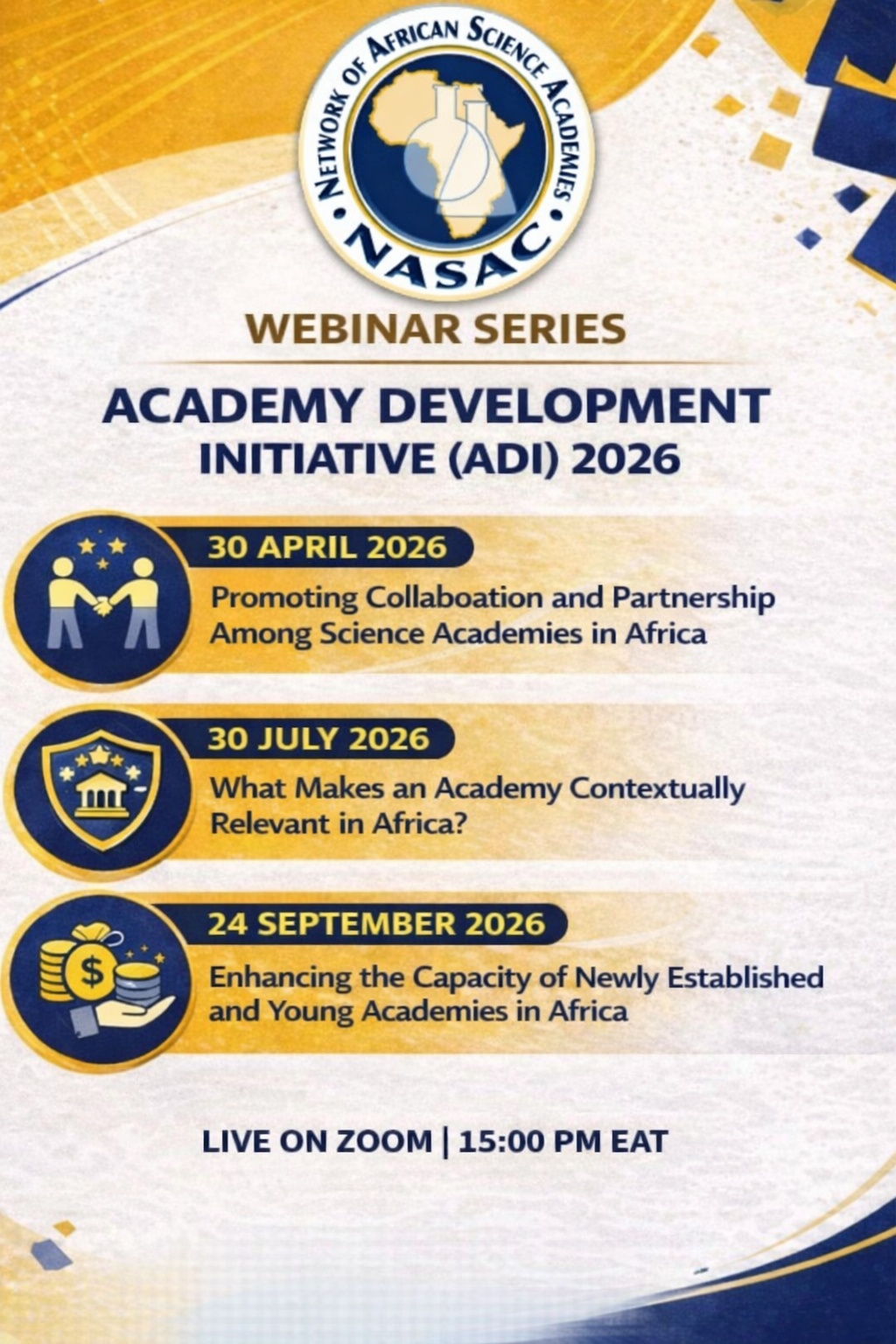
ADI I: Promoting Collaboration and Partnership Among Science Academies in Africa – 30 April 2026
Académie Nationale des Sciences, Arts et Lettres du Bénin
National Workshop on Aquaculture in Benin: Challenges and Opportunities
Fish remains the primary source of animal protein in Benin, yet national consumption is still below the global average, leading to significant dependence on imports. Despite the country’s strong hydrographic potential, aquaculture production remains limited and faces structural challenges.
Fish farming, mainly tilapia and catfish, is practiced nationwide using ponds, tanks, and floating cages. However, the sector relies heavily on imported inputs, particularly feed, resulting in high production costs and reduced profitability. After steady growth up to 2019, production declined due to the COVID-19 pandemic and rising global input prices, leading many farmers to abandon their operations.
In response, Benin has launched strategic reforms under the National Development Plan for the Aquaculture Sector. The national workshop organized by the National Academy of Sciences, Arts and Letters of Benin provided an updated scientific assessment of the sector, highlighted research contributions, and identified innovative pathways to support a more sustainable, competitive, and resilient aquaculture industry.
Seminar on Socio-Anthropological Dimensions of Environmental and Climate Risks in Benin
Benin faces multiple environmental and climate risks, including floods, coastal erosion, land degradation, soil salinization, and increasing rainfall variability. These hazards significantly affect livelihoods, health, and community stability.
While current responses often focus on technical solutions, social and cultural factors, such as risk perceptions, indigenous knowledge, and community adaptation practices remain insufficiently considered. Yet these elements are critical to the effectiveness and sustainability of climate adaptation strategies.
This seminar highlighted the importance of integrating socio-anthropological perspectives into risk management policies. It supports Benin’s commitments under the National Adaptation Plan, Nationally Determined Contributions, and the Sustainable Development Goals, promoting more inclusive and sustainable approaches to environmental and climate resilience.
Conference on Agricultural Reforms in Benin: Land Tenure and Soil Fertility
The conference examined the evolution of agricultural policies in Benin from the colonial era to the present, focusing on two key issues: land tenure and soil fertility. It reviewed the State’s role in shaping the agricultural sector through various policy approaches, from interventionist models to more liberalized systems.
Key reform milestones were discussed, including the transition from the Regional Centers for Rural Development Action (CARDER) to the Territorial Agricultural Development Agencies (ATDA). Despite ongoing reforms, major challenges persist, such as food insecurity, insecure access to rural land, and declining soil fertility.
The presentation emphasized the importance of systematic policy evaluation to improve governance, enhance effectiveness, and ensure sustainable agricultural development in the face of climate change and evolving global pressures.
Cameroon Academy of Sciences
The Cameroon Academy of Sciences concluded elections for its Executive Council in January 2026. The newly constituted leadership reaffirmed its commitment to strengthening science in service of national and international development, with continuity and renewed dedication at the helm.
Nigerian Academy of Science
The Nigerian Academy of Science announced several notable honours and appointments, reflecting the global recognition of Nigerian scientists. These include international advisory appointments, prestigious scientific honours, and global recognition among the world’s most influential leaders in science and health.
The Academy is pleased to highlight the following recent announcements and recognitions involving its distinguished Fellows:
- Professor John Anetor, FAS, a Fellow of the Nigerian Academy of Science and renowned Clinical Toxicologist, has been appointed Special Adviser to the Council of the International Society for Neonatal Screening, serving as the Representative for Sub-Saharan Africa.
- Professor Francisca N. Okeke, FAS, Fellow of the Nigerian Academy of Science and Professor of Geomagnetism and Ionospheric Physics, has been honoured by the International Astronomical Union through the naming of asteroid 149831 “Okeke” in recognition of her outstanding contributions to science.
- Professor Christian Happi, FAS, a Foreign Fellow of the Nigerian Academy of Science, Professor of Molecular Biology and Genomics, and Director of the African Centre of Excellence for Genomics of Infectious Diseases, has been named among the TIME 100 World’s Most Influential People for 2025.
- Professor Ekanem Ikpi Braide, FAS, Immediate Past President of the Nigerian Academy of Science, Professor of Parasitology and Epidemiology, and former Vice-Chancellor of Cross River University of Technology and the Federal University, Lafia, has been conferred with the title of Emerita Professor by the University of Calabar, Nigeria.
Uganda National Academy of Sciences
The Uganda National Academy of Sciences (UNAS) has confirmed its Council Slate for 2025–2028, bringing together a distinguished leadership team drawn from social sciences, economics, communication, mathematics, medicine, and public health. The new Council reflects UNAS’s strong commitment to interdisciplinary scholarship, gender equality, and national development.
In Memoriam
HONOURING PROFESSOR ROSEANNE DIAB
The African scientific community mourns the passing of Professor Roseanne Diab, Vice-President of the Academy of Science of South Africa (ASSAf) and former Executive Officer of the Academy.
A distinguished atmospheric scientist and a global advocate for gender equality in science, Professor Diab made enduring contributions to air quality research, climate science, science policy, and institutional leadership. Her legacy lives on through the institutions she strengthened, the policies she influenced, and the many scientists she mentored across generations.
Professor Diab’s passing is a great loss to ASSAf and to the global scientific community. She will be remembered for her scientific excellence, her generosity of spirit, and her mentorship of scientists across generations.
The Network of African Science Academies (NASAC) was established on 13 December 2001 in Nairobi, Kenya and is currently the affiliate Network for the InterAcademy Partnership (IAP) in Africa.
NASAC is a consortium of merit-based science academies in Africa that aspires to make the “voice of science” heard by policy and decision makers within and outside the continent. NASAC is dedicated to enhancing the capacity of existing national science academies and champions in the cause for creation of new academies where none exist.
- African Academy of Sciences (AAS)
- Algerian Academy of Science and Technology (AAST)
- National Academy of Sciences, Arts and Letters of Benin (ANSALB)
- Botswana Academy of Sciences (BAS)
- The National Academy of Sciences, Arts and Letters of Burkina Faso (ANSB)
- Burundi Academy of Sciences and Technology (BAST)
- Cameroon Academy of Sciences (CAS)
- National Academy of Sciences and Technologies of Congo (ANSTC)
- Congolese Academy of Sciences (ACCOS) Democratic Republic of the Congo
- Academy of Sciences, Arts, Cultures of Africa and African Diasporas (ASCAD), Cote d’Ivoire
- Academy of Scientific Research and Technology (ASRT), Egypt – Provisional Member
- Kingdom of Eswatini Academy of Sciences (KEAS) – Provisional Member
- Académie des Sciences du Mali (ASM)
- Académie des Sciences du Guinée (ASG)
- Ethiopian Academy of Science (EAS)
- Ghana Academy of Arts and Sciences (GAAS)
- Kenya National Academy of Sciences (KNAS)
- Madagascar’s National Academy of Arts Letters and Sciences
- Mauritius Academy of Science and Technology (MAST)
- Hassan II Academy of Science and Technology in Morocco
- Academy of Sciences of Mozambique (ASM)
- Nigerian Academy of Science (NAS)
- Rwanda Academy of Sciences (RAS)
- Academy of Sciences and Techniques of Senegal (ANSTS)
- Academy of Science of South Africa (ASSAf)
- Sudanese National Academy of Science (SNAS)
- Tanzania Academy of Sciences (TAS)
- National Academy of Sciences, Arts and Letters of Togo (ANSALT)
- Tunisia Academy of Sciences Arts and Letters
- Uganda National Academy of Sciences (UNAS)
- Zambia Academy of Sciences (ZaAS)
Zimbabwe Academy of Sciences (ZAS)
Affiliate Members - National Young Academies (NYA's)
Cameroon Academy of Young Scientists
Académie des Sciences pour les Jeunes en République Démocratique du Congo (ASJ-RDC)
Ghana Young Academy (GhYA)
Benin Young Academy of Science
The Nigerian Young Academy
South African Young Academy of Science (SAYAS)
Sudanese Academy of Young Scientist (SAYS)